It seems to happen quite a lot that we pull out some meat from our Chestnut Farms meat CSA, and can't figure out what, exactly, we're dealing with. What are "country style ribs" exactly? "Pork loin sirloin cutlets?" Center cut loin chops vs sirloin chops? It doesn't help that some parts of the animal can have two or more different names.
This site looks like a promising start to figuring it all out.
So does this one Did you know that "pork center loin roast = center cut pork loin roast = pork loin roast center cut = pork center rib roast = center cut pork roast = pork loin rib half = pork loin center cut = pork loin center rib roast"?
Posting them here for easy reference for the next time we succumb to pork bafflement.
Sunday, December 13, 2009

Tuesday, December 8, 2009
Nobu-style Miso Cod
We are splitting a 10-week share in the Cape Ann Fresh Catch community-supported fishery with our friend Diana and her friends. The share alternates weekly between fish and Maine shrimp, and the first share was this week. Ben picked up a huge, whole cod -- and since we are only getting a half-share, I can only imagine the amount of fish/shrimp a whole share would entail! Ben gets all of the props for filleting and preparing the fish. We got six fillets, one bowl of fish chunks destined for a fish curry, and two freezer bags of fish bigs destined for fumet from one cod. Pictures to follow. The first night, I wondered how we could prepare the first two fillets, and I remembered that we had just bought some white miso from the local Asian market the previous weekend. The result: cod baked in miso! The modified recipe, from Epicurious, follows.
******

For Nobu-style Saikyo Miso
1/2 to 3/4 cup white wine
1/2 to 3/4 cup mirin
2 cups white miso paste
1 cup sugar
For cod
4 black cod fillets, about 1/2 pound each
3 cups Nobu-style Saikyo Miso
1/2 to 3/4 cup white wine
1/2 to 3/4 cup mirin
2 cups white miso paste
1 cup sugar
For cod
4 black cod fillets, about 1/2 pound each
3 cups Nobu-style Saikyo Miso

Make Nobu-style Saikyo Miso:
1.Bring the wine and the mirin to a boil in a medium saucepan over high heat. Boil for 20 seconds to evaporate the alcohol.
2. Turn the heat down to low and add the miso, mixing with a wooden spoon. When the miso has dissolved completely, turn the heat up to high again and add the sugar, stirring constantly with the wooden spoon to ensure that the bottom of the pan doesn’t burn. Remove from heat once the sugar is fully dissolved. Cool to room temperature. Makes 3 cups.
1. Pat fillets thoroughly dry with paper towels. Slather the fish with Nobu-style Saikyo Miso and place in a non-reactive dish or bowl and cover tightly with plastic wrap. Leave to steep in refrigerator for 2 to 3 days.
2 Preheat oven to 400°F. Preheat a grill or broiler. Lightly wipe off any excess miso clinging to the fillets but don't rinse it off. Place the fish on the grill, or in a broiler pan, and grill or broil until the surface of the fish turns brown. Then bake for 10 to 15 minutes.
3. Arrange the black cod fillets on individual plates and garnish with hajikami. Add a few extra drops of Nobu-style Saikyo Miso to each plate.
Source Information
Nobu: The Cookbook
Saturday, November 28, 2009
Carrots and Collards
These were big hits at thanksgiving; here are the recipes:
Glazed Carrots with Orange and Ginger
Collards braised in red wine
(For the collards, I ended up using a little more garlic, a bit less oil, and cooking the whole thing longer on lower heat. Also, Viv and I sauteed the collard stems with the garlic for a few minutes before adding the collard leaves)
Glazed Carrots with Orange and Ginger
Collards braised in red wine
(For the collards, I ended up using a little more garlic, a bit less oil, and cooking the whole thing longer on lower heat. Also, Viv and I sauteed the collard stems with the garlic for a few minutes before adding the collard leaves)
Tuesday, November 3, 2009
Excellent Bread
Just a little beer and vinegar give it a lot more flavor. Click on each picture/page for a bigger version (so you can read the type).


Sunday, October 25, 2009
Don't Waste Those Pumpkins
Peter Mayle reports from Provence on the slow penetration of the holiday the French call "alowine." The ghoulish costumes, the trick-or-treating he finds easy to explain to French friend, but jack-o-lanterns are a harder sell:
Anyhow, our first winter CSA delivery came complete with a small pumpkin, and I'm looking forward to carving and then eating it.
I might even try Mme. Farigoule's pumpkin risotto recipe, which Mayle describes thusly:
UPDATE: The risotto itself was delicious, but the pumpkin was gross. Ended up throwing most of it away! Butternut squash is much better.
“Do you mean to tell me,” he said, “that pumpkins all over America are massacred, with all that good honest flesh tossed away, simply to provide a primitive decoration?” He took a deep swig of rosé and shook his head. “Do our American friends know what treasures they’re missing? Pumpkin fritters! Pumpkin and apple sauce — so delightful with sausages! Then, bien sûr, there is Toulouse-Lautrec’s sublime gratin of pumpkin.It is rather ironic that we buy millions of pounds of canned pumpkins to make pie, while millions of pounds of real pumpkin rot on our doorsteps.
“And it must be said that Mme. Farigoule” — he raised his glass to the ceiling in a silent salute — “makes, during the season, a most exquisite pumpkin risotto.” He shook his head again. “No — to sacrifice a pumpkin for such a frivolous purpose as alowine is a waste, a terrible waste. Whatever next?” He allowed me to refill his glass while he recovered his composure, and our conversation moved on to the less sensitive topic of village politics.
Anyhow, our first winter CSA delivery came complete with a small pumpkin, and I'm looking forward to carving and then eating it.
I might even try Mme. Farigoule's pumpkin risotto recipe, which Mayle describes thusly:
The secret is in the preparation of the pumpkin. After removing seeds and fiber, cut the flesh into chunks, leaving the skin still attached. With your hands, mix the chunks in a bowl with 2 or 3 tablespoons of the best olive oil, salt and pepper, a tablespoon of fresh marjoram and a teaspoon of dried oregano. Lay the chunks on a baking tray, skin side down, and put them in the oven, which you have preheated to 425°F. When the chunks of pumpkin are soft and the edges are tinged with brown, remove from the oven and allow to cool, scrape the flesh from the skin and shred with a fork. Prepare your risotto in the usual way and once the rice is ready, stir in the pumpkin, along with freshly grated Parmesan and butter. (Mme. Farigoule’s tip is to be extra-generous with both cheese and butter.) Add a sage leaf for decoration, and a sprinkling of Parmesan, et voilà.
UPDATE: The risotto itself was delicious, but the pumpkin was gross. Ended up throwing most of it away! Butternut squash is much better.
Tuesday, September 22, 2009
making pie easy as pie
Mark Bittman comes through again.
Here's a really easy way to make pie crust. The key is, instead of rolling the dough to fit the top of the pan, you simply cut it into triangles and throw it haphazardly on top. Though not as classic, the final result is still pretty, and it tastes delicious.
Bittman officially calls it "Stone Fruit Patchwork Bake":
8 tablespoons (1 stick) cold unsalted butter, cut into about 8 pieces, more for dish
1 1/2 cups all-purpose flour, more for rolling
1/2 teaspoon salt
3/4 cup plus 2 tablespoons sugar [or to taste - depends on how sweet the fruit is]
3 pounds peaches, seeded and sliced (about 5 large)
1 cup cherries, stones in or pitted
1 tablespoon freshly squeezed lemon juice.
1. Heat oven to 400 degrees and butter a 9-by-13-inch or similar-size baking dish; set aside. In a food processor, combine 1 cup plus 2 tablespoons flour, the salt and 1 tablespoon sugar; pulse once or twice. Add butter and turn on machine; process until butter and flour are blended and mixture looks like coarse cornmeal, about 15 to 20 seconds. Slowly add 1/4 cup ice water through feed tube and process until just combined. Form dough into a flat disk, wrap in plastic and freeze for 10 minutes or refrigerate for at least 30 minutes. (You can refrigerate dough for up to a couple of days, or freeze it, tightly wrapped, for up to a couple of weeks.)
2. Meanwhile, in a large bowl toss fruit with remaining flour, 3/4 cup sugar and lemon juice; place in baking dish.
3. Put dough on a floured board or countertop and sprinkle with more flour. Roll dough into a 12-inch round, adding flour and rotating and turning dough as needed. Cut dough into 3-inch-wide strips, then cut again crosswise into 4-inch-long pieces. Scatter pieces over fruit in an overlapping patchwork pattern.
4. Brush top of dough lightly with water and sprinkle with remaining tablespoon sugar. Transfer to oven and bake until top is golden brown and juices bubble, 35 to 45 minutes. Transfer to a rack to cool; serve warm or at room temperature.
Yield: 6 to 8 servings.
Here's a link to Bittman's helpful (and humorous) video.
I used peaches and blueberries. Here's the result:

And here it is served with homemade vanilla ice cream:

Here's a really easy way to make pie crust. The key is, instead of rolling the dough to fit the top of the pan, you simply cut it into triangles and throw it haphazardly on top. Though not as classic, the final result is still pretty, and it tastes delicious.
Bittman officially calls it "Stone Fruit Patchwork Bake":
8 tablespoons (1 stick) cold unsalted butter, cut into about 8 pieces, more for dish
1 1/2 cups all-purpose flour, more for rolling
1/2 teaspoon salt
3/4 cup plus 2 tablespoons sugar [or to taste - depends on how sweet the fruit is]
3 pounds peaches, seeded and sliced (about 5 large)
1 cup cherries, stones in or pitted
1 tablespoon freshly squeezed lemon juice.
1. Heat oven to 400 degrees and butter a 9-by-13-inch or similar-size baking dish; set aside. In a food processor, combine 1 cup plus 2 tablespoons flour, the salt and 1 tablespoon sugar; pulse once or twice. Add butter and turn on machine; process until butter and flour are blended and mixture looks like coarse cornmeal, about 15 to 20 seconds. Slowly add 1/4 cup ice water through feed tube and process until just combined. Form dough into a flat disk, wrap in plastic and freeze for 10 minutes or refrigerate for at least 30 minutes. (You can refrigerate dough for up to a couple of days, or freeze it, tightly wrapped, for up to a couple of weeks.)
2. Meanwhile, in a large bowl toss fruit with remaining flour, 3/4 cup sugar and lemon juice; place in baking dish.
3. Put dough on a floured board or countertop and sprinkle with more flour. Roll dough into a 12-inch round, adding flour and rotating and turning dough as needed. Cut dough into 3-inch-wide strips, then cut again crosswise into 4-inch-long pieces. Scatter pieces over fruit in an overlapping patchwork pattern.
4. Brush top of dough lightly with water and sprinkle with remaining tablespoon sugar. Transfer to oven and bake until top is golden brown and juices bubble, 35 to 45 minutes. Transfer to a rack to cool; serve warm or at room temperature.
Yield: 6 to 8 servings.
Here's a link to Bittman's helpful (and humorous) video.
I used peaches and blueberries. Here's the result:

And here it is served with homemade vanilla ice cream:

field notes from the kitchen

Name: Fatali Chili
Description: small chili pepper, relatively fat, turns yellow when ripe
Directions:
1.Cut very very small slice of chili, put in mouth. Notice first the interesting and pungent flavor. Note next a bit of heat. Appreciate that this pepper, unlike the previous chilis you've gotten from your CSA, is not bland. Next notice that there is a LOT of heat. Immediately spit very very small slice of chili into the garbage can. Wonder why mouth won't stop burning for next 20 minutes despite drinking several glasses of milk. Observe that this is the first pepper you've eaten that makes your gums hurt.
2. Successfully convince wife to eat even smaller piece of pepper, with same results.
3. Unsuccessfully convince brother in law to eat pepper
4. After two days, compost remaining chunk of pepper, ponder fate of the two others you foolishly picked at the farm on saturday
5. blog about experience
Thursday, September 3, 2009
A Typical Waltham Fields Pick-Up

We finally got around to taking a picture of our Waltham Fields CSA weekly share!
Our haul, clockwise from top left: carrots, Verrill Farm corn, collards, in the colander - Genovese basil, Thai basil and parsley, tomatillos, several kinds of hot peppers, cucumbers, red onions, zucchini, and watermelon. In the middle are globe eggplants and summer squash (including a pattypan squash).
We've also picked our own green, yellow and purple beans, husk cherries, raspberries this week, and strawberries. We've gotten a couple tomatoes saved before late blight got to it, kale, chard, sweet yellow onions, shallots, green bell peppers, kohlrabi, green garlic, potatoes, and beets. I'm sure I'm missing other items, but overall we've been very happy with our CSA (and having a place to put our weekly compost, too, even though our compost bucket is incredibly funky smelling now).
Tuesday, August 11, 2009
A Dream Squashed (and Pulpy)
When we signed up for a summer CSA share this year, nothing excited me more than the promise of heirloom tomatoes: a boundless harvest of reds, yellows, and greens, spotted and striped; of ripe, fragrant tomatoes overflowing from bushels and buckets. So many, I hoped, that I would eat them at every meal, and still have pounds left over to make sauces and preserves to freeze and can. In the last nine months, I’ve hardly bought any tomatoes at the store. Why get inferior, ethylene-gassed fruit, or tiny grape tomatoes shipped all the way from Mexico or Israel? Instead, I would eat seasonally, enjoying tomatoes at the height of their local freshness. The memories of summer gorging, I imagined, would tide me over until next July.
That was before late blight came to New England. Late blight is a fungus that attacks tomato plants when green fruit is already on the vine, and within a few days reduces entire fields of tomatoes, to shriveled heaps of brown and black leaves and stems. It spreads wide, far, and fast, and the only way to protect plants is with massive applications of powerful fungicides—something organic producers cannot do.
Late blight is the same disease that decimated Irish potatoes in the 1840s, resulting in widespread famine, massive emigration, and the proliferation of apostrophed South Boston surnames. It is affecting potatoes here too, but the tomatoes have fared worse. Across the northeast, even into the Ohio valley, the tomato crop is suffering. Blight was spread through infected soil in tomato seedlings sold by big box retailers like Home Depot. And even though our CSA, Waltham Fields, grows their plants from seed, plants in surrounding backyard gardens cast millions of spores into the breeze, dispersing the blight widely. Meanwhile, our cold summer with recordbreaking rains sapped tomato resistance, making the plants even more susceptible.
Here’s how Waltham Fields describes the sad result:
Everyone has been treating this as simply one terrible harvest, but the potato fungus in Ireland returned for several years; will the tomatoes recover next year and the year after?
There is one (potential) bright spot. In May, we planted seven tomato plants in our backyard (5 Sun Golds and 2 Big Beefs). Grown from seed, they have thrived, especially the smaller sungolds—the two that I grew in the Earthbox are nearing 6 feet high, and already have over 100 tomatoes on the vine. The first few have just ripened – and they’re delicious. But they don’t call it late blight for nothing, so I nervously check them every day. Here’s hoping for the best…
That was before late blight came to New England. Late blight is a fungus that attacks tomato plants when green fruit is already on the vine, and within a few days reduces entire fields of tomatoes, to shriveled heaps of brown and black leaves and stems. It spreads wide, far, and fast, and the only way to protect plants is with massive applications of powerful fungicides—something organic producers cannot do.
Late blight is the same disease that decimated Irish potatoes in the 1840s, resulting in widespread famine, massive emigration, and the proliferation of apostrophed South Boston surnames. It is affecting potatoes here too, but the tomatoes have fared worse. Across the northeast, even into the Ohio valley, the tomato crop is suffering. Blight was spread through infected soil in tomato seedlings sold by big box retailers like Home Depot. And even though our CSA, Waltham Fields, grows their plants from seed, plants in surrounding backyard gardens cast millions of spores into the breeze, dispersing the blight widely. Meanwhile, our cold summer with recordbreaking rains sapped tomato resistance, making the plants even more susceptible.
Here’s how Waltham Fields describes the sad result:
Late blight, the fungus-like disease that caused the Irish potato famine, hit our farm early and hard....Heavy on the vines and almost ready to ripen, the fruit turned rotten in a matter of days. From one Saturday to the next, the vines withered and died on their trellises. The second succession, planted right beside the first, was hit next. Despite spraying copper, an organically approved fungicide, we saw the blight appear in our cherry and plum tomatoes as well.(the whole story, describing all of the hard work ruined by the fungus, is here)
Everyone has been treating this as simply one terrible harvest, but the potato fungus in Ireland returned for several years; will the tomatoes recover next year and the year after?
There is one (potential) bright spot. In May, we planted seven tomato plants in our backyard (5 Sun Golds and 2 Big Beefs). Grown from seed, they have thrived, especially the smaller sungolds—the two that I grew in the Earthbox are nearing 6 feet high, and already have over 100 tomatoes on the vine. The first few have just ripened – and they’re delicious. But they don’t call it late blight for nothing, so I nervously check them every day. Here’s hoping for the best…
meet your meat
A little while ago, Viv and I drove 2 1/2 hours out to Hardwick, MA, a little town in central Massachusetts, which is home to Chestnut Farms. We had come to visit the source of the ten pounds of butchered, frozen meat that we pick up every month for our CSA meat share. Chestnut Farms raises chickens, pigs, lambs, cows, turkeys, and now, goats.
As the following pictures show, the animals were well-fed, well-cared for, and pretty damn cute. We were happy to see that even though these critters are killed for our nourishment, they get to live relatively happy lives.
There’s still the matter of the carbon footprint, but that’s a topic for another time…


Feeding the goats

Juvenile pigs (didn't get any pics of the big 300 pounders in another pen). Here are the newborn piglets:


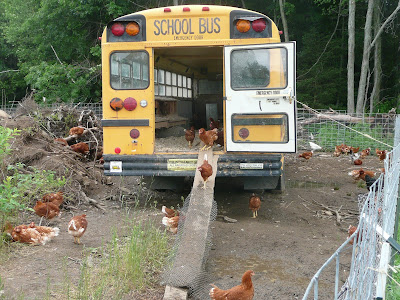
And the chickens (they live in a school bus):
Finally, moo:

As the following pictures show, the animals were well-fed, well-cared for, and pretty damn cute. We were happy to see that even though these critters are killed for our nourishment, they get to live relatively happy lives.
There’s still the matter of the carbon footprint, but that’s a topic for another time…


Feeding the goats

Juvenile pigs (didn't get any pics of the big 300 pounders in another pen). Here are the newborn piglets:


And the chickens (they live in a school bus):

Finally, moo:

Monday, August 10, 2009
Farm to Table dining
In anticipation of our upcoming weekend trip to Vermont (I sure hope that it will be this coming weekend of August 15-16, barring any work emergencies), I found this Top 25 list of Farm to Table restaurants in the U.S. I was searching for the elusive name of a renowned Quechee restaurant in Vermont that focused on locally sourced ingredients. I found out about The Farmers Diner when researching local CSA options in the Boston area, and came across a description of a Vermont CSA that sounded idyllic, but alas, was much too far away and fully contradictory to one of the reasons for joining a CSA in the first place (the proximity of the farms, reduced carbon emissions). This Top 25 list dovetails quite nicely with my previous post on the Top 25 pizza joints in the U.S.!
(Note that we've been on hiatus with the posts...forthcoming posts on our meals at Alinea in Chicago, and O Ya in Boston require substantially more thought and wordsmithing. We'd be giving those temples of fine dining short shrift to merely repeat, "Mmmmm. Yummy. Delicious." and so on and so forth. Also, we have been quite busy enjoying the amazing produce and meat bounty that our produce CSA, Waltham Fields, and our meat CSA, Chestnut Farms, have heaped on us. Lots of simple preparations, with Ben doing most of the heavy lifting.)
Highlights on this list include Chez Panisse (Berkeley, CA), Blue Hill at Stone Barns (Pocantico Hills, NY), The Farmers Diner (Quechee, VT), The French Laundry (Yountville, CA), Momofuku (NYC), and Oleana (Cambridge, MA).
I can attest that Chez Panisse exemplifies the Farm to Table ethos, since Alice Waters is pretty much the mother of the local movement. If we're lucky, Ben and I will make it to the Farmers Diner this weekend (and check out Oleana on some day when we aren't otherwise cooking at home)!
(Note that we've been on hiatus with the posts...forthcoming posts on our meals at Alinea in Chicago, and O Ya in Boston require substantially more thought and wordsmithing. We'd be giving those temples of fine dining short shrift to merely repeat, "Mmmmm. Yummy. Delicious." and so on and so forth. Also, we have been quite busy enjoying the amazing produce and meat bounty that our produce CSA, Waltham Fields, and our meat CSA, Chestnut Farms, have heaped on us. Lots of simple preparations, with Ben doing most of the heavy lifting.)
Highlights on this list include Chez Panisse (Berkeley, CA), Blue Hill at Stone Barns (Pocantico Hills, NY), The Farmers Diner (Quechee, VT), The French Laundry (Yountville, CA), Momofuku (NYC), and Oleana (Cambridge, MA).
I can attest that Chez Panisse exemplifies the Farm to Table ethos, since Alice Waters is pretty much the mother of the local movement. If we're lucky, Ben and I will make it to the Farmers Diner this weekend (and check out Oleana on some day when we aren't otherwise cooking at home)!
Tuesday, July 21, 2009
Top 25 Pizzas in the United States
Serious Eats blogged about the June 2009 issue of GQ magazine, and its ranking of the top 25 pizza joints in the U.S. here; their Top 25 list is below. I'll have to check out the two Boston finishers sometime; in addition to those two, I've heard that Emma's in Cambridge is a must-try as well!
01. Great Lake (Chicago)
02. Lucali (Brooklyn, NYC)
03. Pizzeria Delfina (San Francisco)
04. Pizzeria Bianco (Phoenix)
05. Bob & Timmy's (Providence, R.I.)
06. Sally's Apizza (New Haven, Conn.)
07. Tomato Pie (Los Angeles)
08. Co. Company (Manhattan, NYC)
09. Tacconelli's (Philadelphia)
10. Totonno's (Brooklyn, NYC)
11. Tarry Lodge (Port Chester, N.Y.)
12. Frank Pepe (New Haven, Conn.)
13. Luigi's "the Original" (Harrison Township, Mich.)
14. Gialina (San Francisco)
15. Buddy's (Detroit)
16. Antica Pizzeria (Marina Del Ray, Calif.)
17. A16 (San Francisco)
18. Al Forno (Providence, R.I.)
19. Galleria Umberto (Boston)
20. Famous Joe's (Manhattan, NYC)
21. Tomatoes Apizza (Farmington Hills, Mich.)
22. Osteria (Philadelphia)
23. Santarpio's (Boston)
24. Niki's (Detroit)
25. Una Pizza Napoletana (Manhattan, NYC)
01. Great Lake (Chicago)
02. Lucali (Brooklyn, NYC)
03. Pizzeria Delfina (San Francisco)
04. Pizzeria Bianco (Phoenix)
05. Bob & Timmy's (Providence, R.I.)
06. Sally's Apizza (New Haven, Conn.)
07. Tomato Pie (Los Angeles)
08. Co. Company (Manhattan, NYC)
09. Tacconelli's (Philadelphia)
10. Totonno's (Brooklyn, NYC)
11. Tarry Lodge (Port Chester, N.Y.)
12. Frank Pepe (New Haven, Conn.)
13. Luigi's "the Original" (Harrison Township, Mich.)
14. Gialina (San Francisco)
15. Buddy's (Detroit)
16. Antica Pizzeria (Marina Del Ray, Calif.)
17. A16 (San Francisco)
18. Al Forno (Providence, R.I.)
19. Galleria Umberto (Boston)
20. Famous Joe's (Manhattan, NYC)
21. Tomatoes Apizza (Farmington Hills, Mich.)
22. Osteria (Philadelphia)
23. Santarpio's (Boston)
24. Niki's (Detroit)
25. Una Pizza Napoletana (Manhattan, NYC)
Sunday, June 14, 2009
Craigie on Main
Last weekend, Ben and I went to Craigie on Main in Central Square, Cambridge after seeing an evening of comedy put on by the graduating students of the American Repertory Theater institute (or something like that). The show was hilarious and entertaining (and a great follow-up to the AmRep's production of "Romance" by David Mamet, which we saw the previous weekend).
We've been dying to go to Craigie ever since Cochon 555, a fundraiser we attended which showcased the talents of 5 local chefs as they each prepared a heritage breed of pig. Tony Maws, Craigie's chef-owner, was one of the chefs participating and he had made some amazing pork preparations that made me want to visit his restaurant.
So, after the show concluded, we rushed to Craigie to make their final seating on Saturday night, which was 10:30pm. Boy, am I glad we made it. I had wanted to try a cocktail from the bar, since I've heard really good things about the talent there. I had the Blinker, which is rye whiskey, grapefruit juice, and grenadine topped with a little grapefruit rind. The drink was pink, light and went down easily.
For our meal, we chose the "Chef's Farm Menu" which is composed of your choice of an amuse bouche, appetizer, entree, and dessert (paired with a dessert wine). Everything was great! Ben started off with the house cured pork belly, and I had the house cured Greek style sardines. For the appetizer, I had a ragout of sweetbreads, wild mushrooms, and baby turnips, topped with a poached farm egg. Ben had the tempura-style soft shell crab. For entrees, I had the Vermont pork two ways: confit and pork belly. Ben had the halibut on top of a parsnip puree. The best part of eating out with Ben is that when we try new restauarants, we end up splitting our plates so that we get to try each other's food. I loved the ragout and pork the best - you can't really go wrong with dishes that have mushrooms or pork, if you ask me. Ben enjoyed the sweetbreads a lot, and I was satisfied by them, but I don't know if I'm a huge fan. It was our first time eating sweetbreads, and I don't know why they have such a scary reputation!
For dessert, Ben opted for Craigie's three fruit sorbets (pineapple, mango, blood orange) paired with sparkling wine, and I chose the vanilla panna cotta with strawberry coulis, paired with a very sweet white dessert wine. Panna cotta was the perfect way to end a rich meal, and we also got two mini madeleines to finish off the evening. It was a really perfect meal, with great service, and we are definitely going back! I was also impressed to see Tony Maws, the chef-owner, in the open kitchen as we walked in, slicing a tempura-fried soft shell crab in half with a HUGE knife and plating it. He was in the kitchen until the very end, and as I went to the bathroom at the end of the meal I saw Chef Maws sitting in the dining room at a table with one of the employees, having their dinner. It's very cool to see chefs working in their restaurants; granted, this is his only restaurant, so he doesn't need to spend his time shuttling between multiple locations, but I still appreciate it when a chef is in his kitchen supervising and cooking.
Unfortunately, we forgot to bring our camera, so I promise to take pictures of our NEXT meal at Craigie.
We've been dying to go to Craigie ever since Cochon 555, a fundraiser we attended which showcased the talents of 5 local chefs as they each prepared a heritage breed of pig. Tony Maws, Craigie's chef-owner, was one of the chefs participating and he had made some amazing pork preparations that made me want to visit his restaurant.
So, after the show concluded, we rushed to Craigie to make their final seating on Saturday night, which was 10:30pm. Boy, am I glad we made it. I had wanted to try a cocktail from the bar, since I've heard really good things about the talent there. I had the Blinker, which is rye whiskey, grapefruit juice, and grenadine topped with a little grapefruit rind. The drink was pink, light and went down easily.
For our meal, we chose the "Chef's Farm Menu" which is composed of your choice of an amuse bouche, appetizer, entree, and dessert (paired with a dessert wine). Everything was great! Ben started off with the house cured pork belly, and I had the house cured Greek style sardines. For the appetizer, I had a ragout of sweetbreads, wild mushrooms, and baby turnips, topped with a poached farm egg. Ben had the tempura-style soft shell crab. For entrees, I had the Vermont pork two ways: confit and pork belly. Ben had the halibut on top of a parsnip puree. The best part of eating out with Ben is that when we try new restauarants, we end up splitting our plates so that we get to try each other's food. I loved the ragout and pork the best - you can't really go wrong with dishes that have mushrooms or pork, if you ask me. Ben enjoyed the sweetbreads a lot, and I was satisfied by them, but I don't know if I'm a huge fan. It was our first time eating sweetbreads, and I don't know why they have such a scary reputation!
For dessert, Ben opted for Craigie's three fruit sorbets (pineapple, mango, blood orange) paired with sparkling wine, and I chose the vanilla panna cotta with strawberry coulis, paired with a very sweet white dessert wine. Panna cotta was the perfect way to end a rich meal, and we also got two mini madeleines to finish off the evening. It was a really perfect meal, with great service, and we are definitely going back! I was also impressed to see Tony Maws, the chef-owner, in the open kitchen as we walked in, slicing a tempura-fried soft shell crab in half with a HUGE knife and plating it. He was in the kitchen until the very end, and as I went to the bathroom at the end of the meal I saw Chef Maws sitting in the dining room at a table with one of the employees, having their dinner. It's very cool to see chefs working in their restaurants; granted, this is his only restaurant, so he doesn't need to spend his time shuttling between multiple locations, but I still appreciate it when a chef is in his kitchen supervising and cooking.
Unfortunately, we forgot to bring our camera, so I promise to take pictures of our NEXT meal at Craigie.
Thursday, May 14, 2009
Coming soon to Harvard Street, Brookline
HOLY COW!
Check out this place: DORADO TACOS & CEMITAS!!!!!
I have no idea what a Cemita is - apparently it's a torta-like Mexican sandwich - but I am INCREDIBLY EXCITED ABOUT the FOUR (4)!!! kinds of fish tacos that will be served at Dorado. And they will have elote - Mexican grilled corn with chili, lime and cotija cheese! I've been craving elote for a while now! Last time we had it, we were living in NYC and ate delicioso Cuban food at Cafe Havana near SoHo. The corn gets stuck in your teeth because you slobber all over it to get the yummy chili and cheese in each bite, but it's well worth the mess.
I'm drooling over the menu right now. Dorado won't open until June. Anna's better brace itself for the competition down the street - I think this place will be our new go-to place for Mexican take-out, provided that the food is at good as menu suggests. And I better brace myself for the incredible fatness headed to my belly!
Check out this place: DORADO TACOS & CEMITAS!!!!!
I have no idea what a Cemita is - apparently it's a torta-like Mexican sandwich - but I am INCREDIBLY EXCITED ABOUT the FOUR (4)!!! kinds of fish tacos that will be served at Dorado. And they will have elote - Mexican grilled corn with chili, lime and cotija cheese! I've been craving elote for a while now! Last time we had it, we were living in NYC and ate delicioso Cuban food at Cafe Havana near SoHo. The corn gets stuck in your teeth because you slobber all over it to get the yummy chili and cheese in each bite, but it's well worth the mess.
I'm drooling over the menu right now. Dorado won't open until June. Anna's better brace itself for the competition down the street - I think this place will be our new go-to place for Mexican take-out, provided that the food is at good as menu suggests. And I better brace myself for the incredible fatness headed to my belly!
Thursday, April 9, 2009
Liberation Garden
Ya'll may have heard that the Obamas have sent foodie hearts afluttering all across America with their decision to plant an organic garden on the white house lawn. And it's no joke: Today, Michelle Obama helped plant the first seedlings, along with some local schoolchildren (err, some local schoolchildren helped to plant the seeds; Michelle wasn't planting any children). I have my doubts as to how often either Michelle or Barack will be getting their hands dirty (especially if there aren't any cameras around) but I love the idea anyway.
James Wimberly makes the point, though, that this garden is more than a statement about eating local, organic, and healthy. It revives the tradition of the founders, who kept gardens (and livestock) on white house grounds, but also recalls the practice of slaves being allowed an off day, one day a week to tend their own personal plots. Now the descendant of slaves will have others to help her produce food close to home:
PS - viv and i just received our seeds in the mail, and we're looking forward to our own garden once it stops freezing around here! (Assuming of course, that us novice gardeners kill less than 100% of the plants)
The Obamas will feed their love of Mexican food with cilantro, tomatillos and hot peppers. Lettuces will include red romaine, green oak leaf, butterhead, red leaf and galactic. There will be spinach, chard, collards and black kale. For desserts, there will be a patch of berries. And herbs will include some more unusual varieties, like anise hyssop and Thai basil. A White House carpenter, Charlie Brandts, who is a beekeeper, will tend two hives for honey
 Today, Michelle Obama helped plant the first seedlings, along with some local schoolchildren (err, some local schoolchildren helped to plant the seeds; Michelle wasn't planting any children). I have my doubts as to how often either Michelle or Barack will be getting their hands dirty (especially if there aren't any cameras around) but I love the idea anyway.
James Wimberly makes the point, though, that this garden is more than a statement about eating local, organic, and healthy. It revives the tradition of the founders, who kept gardens (and livestock) on white house grounds, but also recalls the practice of slaves being allowed an off day, one day a week to tend their own personal plots. Now the descendant of slaves will have others to help her produce food close to home:
So the White House kitchen garden marks a full stop at the end of a long line of gardens of slaves and gerdens tended by slaves. Eleanor Roosevelt launched victory gardens. Michelle's is a liberation garden.
PS - viv and i just received our seeds in the mail, and we're looking forward to our own garden once it stops freezing around here! (Assuming of course, that us novice gardeners kill less than 100% of the plants)
Subscribe to:
Posts (Atom)